
Application-led engineering
Special-Environment & Medical Motor Engineering
Special-environment and medical motor engineering starts with exposure conditions and qualification requirements. Vacuum, sterilization and magnetic-field constraints can demand different materials, thermal paths and even different motion technologies.
Review My Application →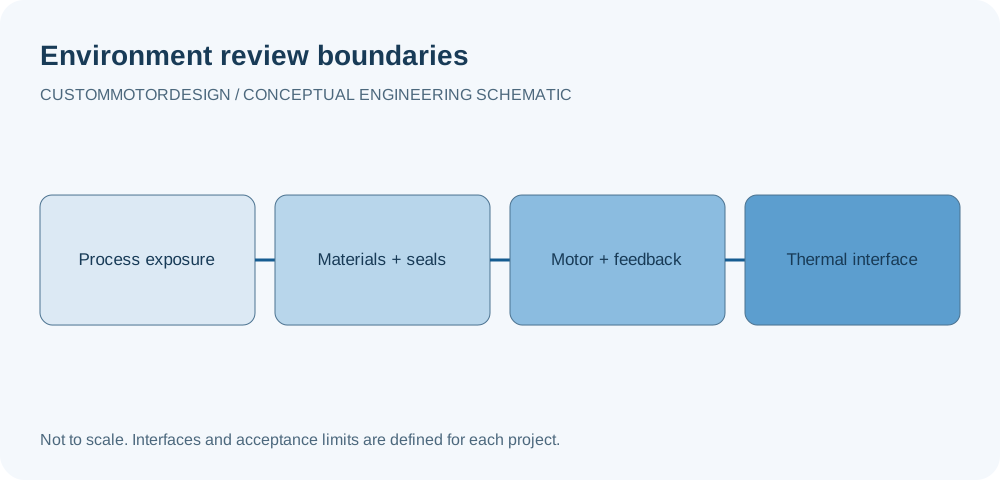
Separate environmental requirements before choosing a motor
| Requirement | Design questions | Evidence to agree |
|---|---|---|
| Vacuum operation | Pressure, gas load, bakeout, lubricant, cable and adhesive compatibility. | Material records, cleaning process and tests at the stated pressure and temperature. |
| Cleaning or sterilization | Agent, concentration, temperature, duration and number of cycles. | Assembly-level exposure testing and post-cycle functional checks. |
| Magnetic environment | Static field, field gradient, operating location and interference constraints. | Material assessment, force/torque and functional evaluation for the intended environment. |
| Temperature extremes | Ambient range, internal heat, insulation and dimensional changes. | Thermal cycling, sensor checks and performance at defined boundary conditions. |
Architecture comparison for project scoping. Configuration-specific ratings and qualification remain subject to engineering review.
Vacuum changes both material selection and heat removal
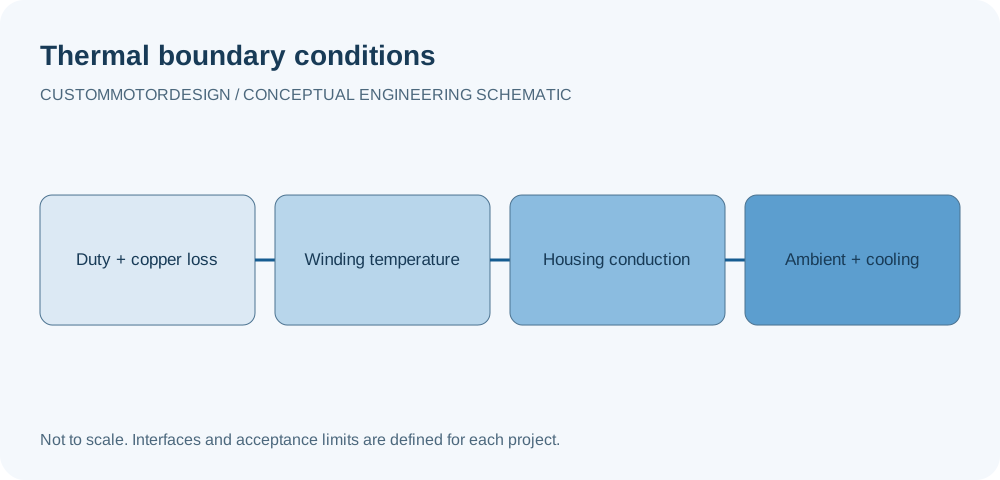
In vacuum, reduced gas convection changes the heat balance of the motor assembly. Heat must leave through the paths available in the installed equipment. The review should include duty cycle, conductive interfaces, allowable surface temperatures and the location of temperature measurements.
Adhesives, insulation, coatings, lubricants and cable materials can all contribute to outgassing or contamination. Pressure alone is not a complete specification: provide the process environment, acceptable gas load, cleanliness criteria and any bakeout profile. “Vacuum compatible” should describe a defined configuration and test scope, rather than a label applied to a motor family.
- Operating and base pressure, gas species and contamination sensitivity
- Bakeout temperature, duration and which parts are exposed
- Cooling interfaces and required cleanliness documentation
Medical equipment requires a device-specific integration plan
A motor for a pump, surgical tool or laboratory mechanism encounters different loads and exposure conditions. Specify whether it is sealed inside reusable equipment, exposed to cleaning agents or part of a disposable assembly. Include duty, noise, leakage-current constraints and maintenance access where relevant to the device design.
Sterilization compatibility cannot be inferred from a metal housing or a motor technology. Repeated exposure can affect insulation, bearings, adhesives and feedback. Define the actual process and cycle count, then agree assembly-level verification. The equipment manufacturer must establish the applicable device requirements and approval pathway.
- Cleaning and sterilization process with exposure boundaries
- Post-exposure torque, insulation, feedback and seal acceptance
- Traceability, change notification and documentation needs
Treat MRI and strong magnetic fields as a separate assessment
A permanent-magnet motor should not be presented as suitable for an MRI environment merely because another component uses nonmagnetic material. Static fields, gradients and RF conditions can introduce mechanical, thermal and functional concerns. Describe location and intended operating conditions before discussing feasibility.
Nonmagnetic piezoelectric actuation is one alternative architecture used in precision motion, with its own force, travel, drive and integration tradeoffs. A published component reference is useful background; it does not qualify a custom assembly for your scanner or medical device. Any environment-specific claim requires the relevant assessment and evidence.
- Exact location relative to the field and whether motion occurs during imaging
- Permitted materials, interference and temperature criteria
- Who owns qualification, test fixtures and final device integration
Need drawings or validation documents for your review?
Request dimensional drawings or STEP CAD, performance and thermal reports, interface information or quality documentation. Include the candidate configuration, operating conditions and revision requirements so the engineering team can confirm what applies and what can be shared.
Request Engineering Documents →Bring these inputs to the first review.
- Pressure, temperature, cleaning, sterilization or magnetic-field conditions
- Load, speed, motion type, duty cycle and available thermal paths
- Materials restrictions, contamination criteria and qualification protocol
- Required records, responsible approval team, prototype quantity and volume
Unknown parameters are welcome. Mark them for engineering guidance. Start with a non-confidential brief; request an NDA and a suitable exchange channel before sharing restricted drawings.
Submit a Project →Four-step turnkey workflow
Connect each stage to an engineering decision.
01
Engineering & feasibility
Baseline the duty, interfaces and risks. Agree analysis deliverables and a build decision.
02
Rapid prototyping
Release a defined revision, sample quantity and acceptance plan with a scoped schedule.
03
Testing & support
Measure at agreed operating points, review deviations and resolve drive or assembly integration.
04
Production transfer
Approve pilot evidence, critical characteristics, traceability and change controls.
Engineering questions
Are these certified medical or MRI-approved motors?
This is an engineering assessment offering, not a certification claim or an approved device catalogue. Configuration-specific evidence and the applicable qualification responsibilities must be agreed.
Can one motor be qualified for vacuum and sterilization together?
Potentially, but these requirements must be evaluated jointly. Materials, sealing, lubrication and thermal design that suit one exposure may be unsuitable for another.
What if our environment requirements are confidential?
Send a non-confidential outline and request an NDA and controlled file-transfer discussion. Do not upload restricted drawings through the public inquiry form.
Engineering scope reviewed .
Technical references
Primary technical background for the architecture discussion. These references describe their publishers’ work; they are not evidence of CustomMotorDesign model performance, partnerships or certification.